On Listening, Preserving, and the Question of What Emerges When an Old Building Is Not Imposed Upon — but Understood
Old houses do not speak loudly. They speak through floorboards that bend under certain footsteps. Through doorframes that stand ever so slightly askew. Through layers of plaster beneath which earlier colour choices lie hidden, like growth rings in a tree. Those who listen learn something. Those who renovate too quickly overwrite it.
The house at Pötzleinsdorfer Straße 93 stands on one of Vienna’s oldest continuously settled streets. Pötzleinsdorf itself was first documented in 1112 — a linear village stretching along a single axis through the valley of the Währinger Bach, leading directly to the palace. What is today Pötzleinsdorfer Straße was, for centuries, simply the main road — the only one. It was not until 1894 that it was officially named after the district it had always served.
For a long time, the area retained the character of a wine-growing village. Vintners cultivated the slopes around Schafberg before the grand bourgeois villas of the Gründerzeit began to shape the area from the second half of the 19th century onward. To this day, a sculpture at the beginning of the street commemorates the vintner — a figure standing in silence and firmly grounded, holding his place while the city has grown up around him. It is not an accidental image.
“A vintner does not work against the material. He works with it — with patience, with observation, with the knowledge that the best results come when you trust the place you are shaping.”
The House in Its Time
The building at No. 93 is part of the streetscape that still defines Pötzleinsdorfer Straße today: Gründerzeit and historicist architecture, set within front gardens, on sloping ground, with a certain reserve towards the street. The building line is set back, the houses stand on their own plots, as if aware of their own dignity. They were built for people who did not merely live in Pötzleinsdorf — but chose the place because it offered something the city, in all its density, could not: air, silence, greenery.
This house contains all of these layers within it. Residents came and went, uses changed, and time left its marks — as it always does where surfaces have not simply been covered over with a fresh coat, but where the existing substance has been preserved, sometimes with frugality. When the current owners took over the building, it was not an act of blind romanticism. It was a decision.
Renovating with Care
The restoration did not follow an aesthetic of the new. It followed a question: what is still here, what was good, and what has earned the right to remain?
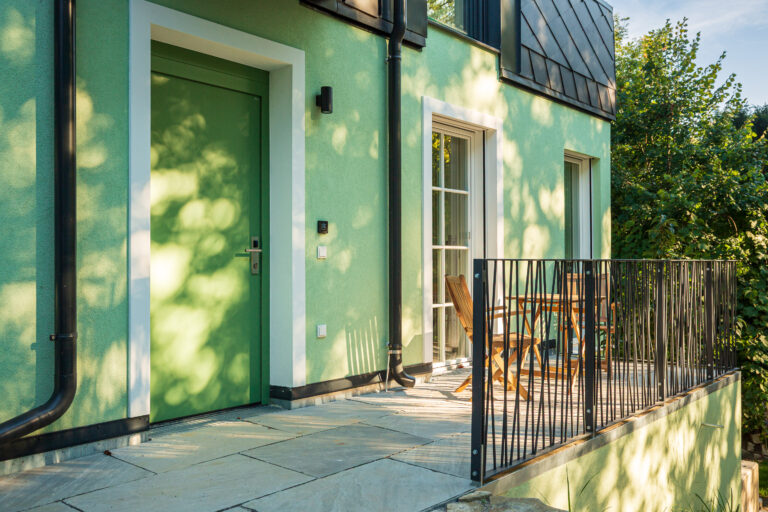
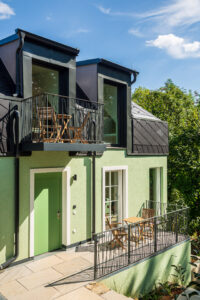
Old floor coverings were uncovered, cleaned, repaired and relaid — not because that would have been cheaper, but because no new material could ever have created that patina. The old walls remained. And as layers were removed from the façade, it told its own story: beneath the newer coats lay older colours — and they were taken seriously. The green of today’s courtyard façade is not merely a design decision, but a rediscovery. On the street side, the yellow was preserved — the same yellow that had shaped the appearance of Pötzleinsdorfer Straße for generations. Not as a nostalgic gesture, but as a sign of respect for what a house knows about itself.
The Vintner as a Mindset
Das Winzer is not called that by accident. The name is its programme — and it closes a circle that runs through the history of this place. The vintners who once worked the slopes around Pötzleinsdorf were not producers in some anonymous sense. They knew their piece of land. They understood which slope would yield which character, which vintages demanded patience and which were generous. From a specific place, they brought forth something that could not have emerged anywhere else — because it was rooted in that place, and in that depth.
This mindset is the philosophy of Das Winzer. Not hospitality in the narrow sense of service and room numbers. But a deep familiarity with the place — with its history, its neighborhood, its seasons, its restaurants and bakeries and park paths.
What emerges when a house is returned to its place with patience, craftsmanship and deep rootedness — that is Das Winzer.
Pötzleinsdorfer Straße 93.
Long established. Now ready.